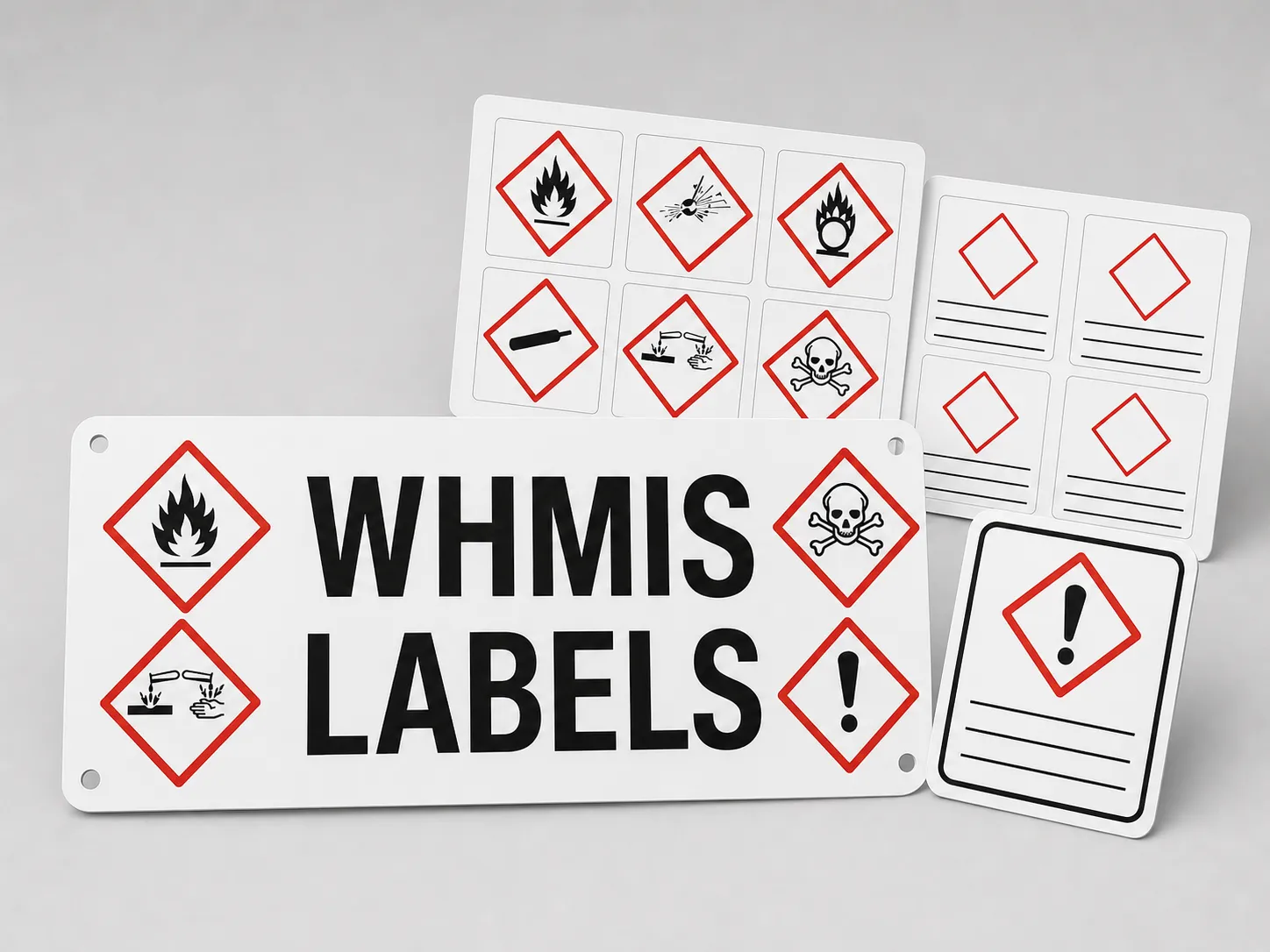
WHMIS labels, exit signs, first-aid and hazard signage to Ontario OHSA spec. A missing or faded sign is a liability and an order to remedy — post it right the first time.
We are a private sign and decal supplier. The requirement to display safety signage comes from the references below — not from us. We source-check each one and build to match the published display requirement. Always verify the final specification with the relevant authority for your building.
O.REG 213/07
Ontario Fire Code
Fire routes should be identified with signs posted at the route entrance, and occupant load should be posted in a conspicuous location in assembly occupancy spaces. Verify your approved load with your local fire department.
Exit and egress signage and occupant-load posting are set by the Building Code and your building permit. The number on an occupancy sign must match the load approved by your building inspector — it is not chosen by the supplier.
Accessible signage uses high-contrast formatting and, where required, tactile/Braille inserts under the AODA Integrated Accessibility Standards Regulation. We build to match published accessibility display requirements.
Fire-route designation and wording (for example "NO PARKING FIRE ROUTE") is typically mandated by local municipal bylaw. Confirm exact wording and placement with your municipality before installation.
One order for fire-route, exit, occupancy and accessible signage across every unit or site. Tell us the buildings and we’ll price the set — source-checked and shipped from Niagara.
On compliancelettering.ca, the safety family covers fire-route signs, exit and egress signage, occupancy-load (maximum occupancy) signs, accessible parking and AODA building signage, and reflective conspicuity markings. We are a private sign and decal supplier — we produce the signage; the underlying requirement comes from the Fire Code, Building Code, AODA, or local bylaw.
Q. 02
How do I know what my occupancy-load number should be?
The number on an occupancy-load sign must match the load approved for your space by your local fire department or building inspector during permit and fire-safety-plan approval. It is not chosen by the supplier. You can find it in your fire safety plan, building permit documents, or by asking your municipality. We then build the sign to match.
Q. 03
Do your fire-route signs use the right wording?
Fire-route wording and placement are typically set by local municipal bylaw — most commonly "NO PARKING FIRE ROUTE" or "FIRE ROUTE NO PARKING". We build to match the published format for your municipality; confirm the exact wording with your local fire department or municipality before installation.
Q. 04
Are your accessible signs accessible?
We build accessible signage to match the published display requirements under the AODA Integrated Accessibility Standards Regulation — high-contrast formatting and, where required, tactile or Braille inserts. As with any compliance product, verify the final specification against the relevant authority for your building.
§ KITCompliance-ready kit
Jobsite Ready Label Kit
The hazard, PPE and notice signage a jobsite or facility needs to pass a walk-through — source-checked and built to match the display requirement, produced as one matched set.
Compliance Lettering is a private sign and decal supplier. We are not a government agency and are not affiliated with the Office of the Fire Marshal, your municipality, or any authority. Our products are source-checked and built to match published display requirements; they do not replace your obligation to verify the final specification, wording and placement with the relevant authority for your building. Occupancy-load figures must match the load approved by your fire department or building inspector.